
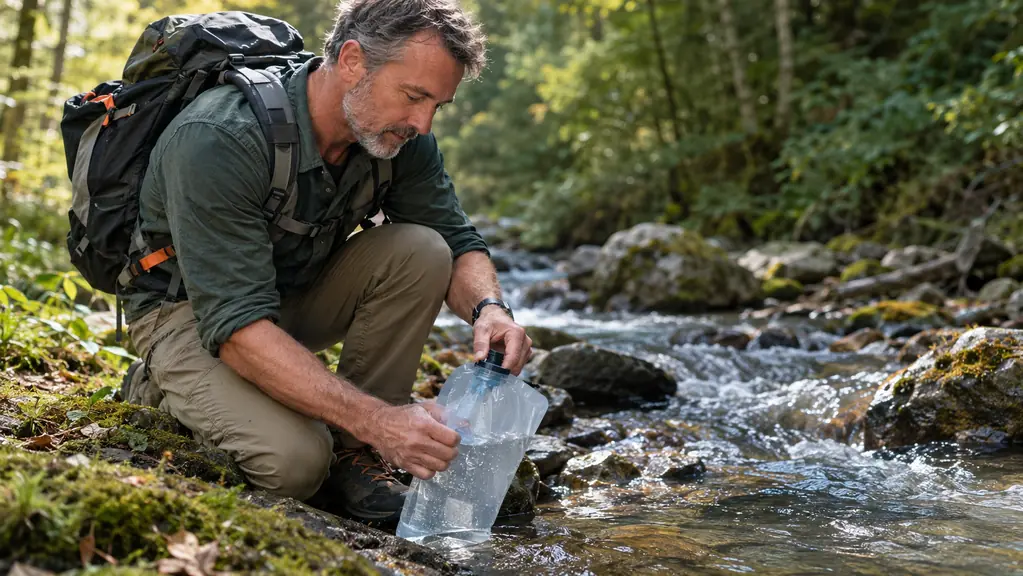
The first time I used the Sawyer Squeeze, I was standing in a creek off the Sheltowee Trace with a map case hanging from my neck and my TETON pack sitting heavy on my shoulders. I had spent the last three trips carrying a cheap big-box filter that clogged halfway through day two, and I was tired of boiling water twice a day. I bought the Sawyer Squeeze on a Tuesday, backflushed it in the kitchen sink that night, and packed it for a three-day loop in the Red River Gorge.
A season later, that same Sawyer has filtered every drop I drank on trail, plus a few gallons I gave to a couple of thru-hikers who had run out of tablets. It has been dropped on rocks, frozen overnight in my car (which I do not recommend), and squeezed until my palms ached. It still works. That is the whole review in one sentence, but I will give you the details because the details are what matter when you are two miles from the car and the water in front of you looks like tea.
The Quick Verdict
The Sawyer Squeeze is the filter I reach for every trip now. It weighs almost nothing, filters fast, and has survived a full season of abuse without a single clog I could not clear with a backflush.
Amazon Check Today's Price →A full season of drinking straight from creeks and ponds
The Sawyer Squeeze has handled every water source I have thrown at it, from clear spring runs to silt-heavy puddles after a rain. If you are tired of tablets that leave an aftertaste or pumps that weigh a pound, this is the filter to put in your pack.
Amazon Check Today's Price on Amazon →How I've Used It
I carried the Sawyer Squeeze on every backpacking trip this season. That means two solo overnights in the Red River Gorge, a four-day stretch on the Sheltowee Trace, a weekend at Big South Fork, and the annual week in the Smokies, where Dana and I car camped for part of it. On the solo trips, the Squeeze was my only water treatment. On the car-camping part, I still used it because the campground spigot tasted like the inside of a garden hose.
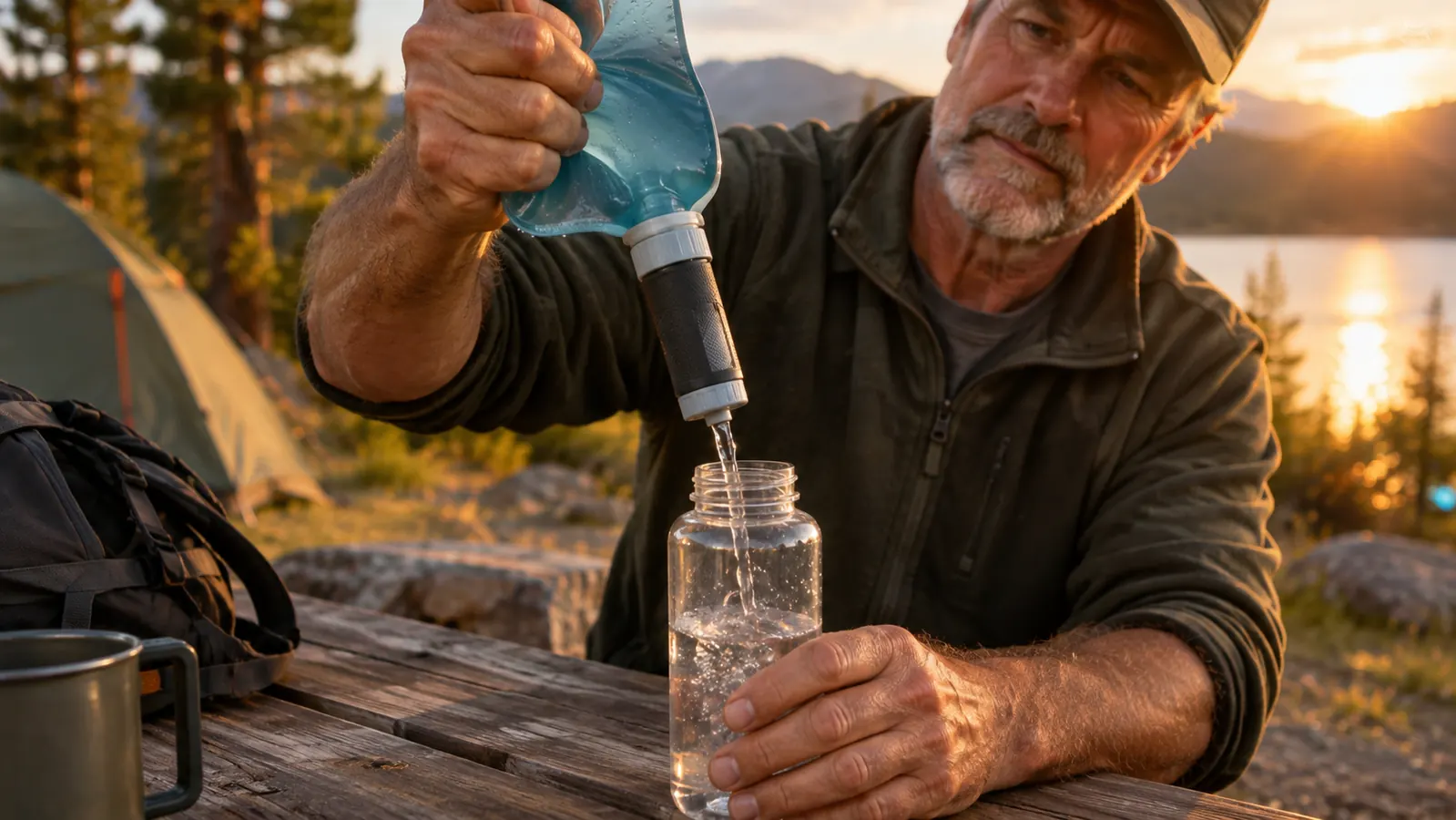
My routine never changed much. I would find a water source, scoop water into one of the two 32-ounce pouches, screw the filter onto the pouch, and squeeze it into my clean bottle. The first few squeezes are easy. The last few, when the pouch is almost empty, take a little more effort. I learned to stop when the pouch is still about a quarter full, because the last bit is not worth the hand fatigue.
Backflushing became a habit. I carry the little syringe that comes with it, and every couple of liters I backflush with clean water until it runs clear. On the Sheltowee Trace, after filtering from a creek that had been churned up by a storm, I backflushed twice in one day. The flow rate came right back. That is the moment I stopped worrying about whether I had made the right choice.
I also used it in gravity mode a few times. You can hang a full pouch from a tree branch, let the filter hang below it, and let gravity do the work. It is slower than squeezing, maybe a liter every ten minutes, but it is nice when I am setting up camp and my hands are busy with tent stakes. I do not carry the extra hardware for it, but a piece of cord from my repair kit is enough.
I usually drive to the trailhead in my 2016 Subaru Outback with the filter packed in the lid pocket of my TETON pack, right next to my Black Diamond trekking poles. The routine is the same every time: park, lace up, fill the pouches at the first reliable source, and get moving. The filter has never once leaked in the car, which is more than I can say for the big-box filter it replaced.
What the Specs Don't Tell You
The Sawyer Squeeze weighs about three ounces with the filter and one pouch. That is light enough that I stopped noticing it in my pack after the first mile. The whole system, including both pouches and the syringe, is still under seven ounces. For a guy with a cranky left knee and a lower back that complains about every unnecessary pound, that matters more than any flow-rate number.
What the spec sheet does not tell you is how the filter fits in your hand. The Squeeze is a small cylinder, about the size of a fat marker, with threads on both ends. You screw a pouch on one side and a bottle on the other. The grip is easy to hold even with cold, wet hands. I have used filters with separate hoses and pumps that required two hands and a lap table. This one just needs one hand and a steady squeeze.
The pouches are the weak point, and I will say that plainly. The 32-ounce pouches that come with it are thin and roll up small, but they are not built for a lifetime. I punctured one on a sharp branch in the Smokies and had to patch it with tape for the rest of the trip. Sawyer sells replacement pouches, and I will buy a couple before next season. The filter itself is the part that has earned my trust.
Another thing the specs do not mention is how the filter behaves in cold weather. On a frosty October morning in the Red River Gorge, the water was cold enough that my hands went numb before I finished the first liter. The filter got noticeably slower. It still worked, but I had to squeeze harder and longer. If you hike in freezing conditions, plan for a slower filter or keep it inside your jacket between uses.
Backflushing Is the Whole Game
Here is what nobody tells you about the Sawyer Squeeze: it is only as good as your backflushing. The filter is a hollow fiber membrane. When you squeeze water through it, the good stuff goes through the fibers and the bad stuff stays on the outside. If you never clean the outside, the flow rate drops to a trickle and you start blaming the filter for what is really a maintenance problem.
The included syringe is small and plastic, and it works. You fill it with clean water, screw it into the filter, and push. The water goes backward through the fibers and pushes the crud off. I do this every couple of liters, and the flow rate stays fast. On the Sheltowee Trace, after filtering from a muddy creek, I backflushed three times in a row and the water coming out the other side was clear again.
One tip I picked up: backflush before you store the filter, not just when you are on trail. At the end of each trip, I run clean water through it, backflush with the syringe, and let it air dry in the kitchen. A filter that goes into storage wet and dirty is a filter that will smell like a swamp by spring. Mine does not smell like anything, which tells me the routine is working.
I will also say that the backflushing syringe is easy to lose. It is small and clear and it rolls. I keep mine in a ziplock bag with the filter, and I still managed to leave it at home once. That trip, I used the clean water from my bottle to backflush by holding the filter upside down and forcing water through with my mouth. It worked, but it was not as good as the syringe. Now I check for the syringe before I close the pack.
How It Handles Different Water Sources
I have filtered from a lot of different water this season. Clear spring runs in the Red River Gorge, slow-moving creek pools in Big South Fork, a pond that had a suspicious green film on one end, and the always-popular Smokies streams that have more hiker traffic than fish. The Squeeze handled all of it. The only difference was how often I had to backflush.
The green pond water was the real test. I scooped from the clear side, away from the film, and the filter did its job. The water that came out was cool, clear, and tasteless. I am not going to tell you it tasted like mountain spring water, because it did not. It tasted like nothing, which is exactly what I want from a filter. I have had enough giardia scares from my early camping years to know that tasteless is a win.
The one thing I avoid is water that has been sitting in a beaver pond for a month. Not because the filter cannot handle it, but because the flow rate drops so fast that you will spend more time backflushing than drinking. For that kind of water, I would rather carry a little extra and filter from a moving source. That is a planning issue, not a filter issue.
I also filtered for other people a few times. On the Sheltowee Trace, I met a couple who had run out of purification tablets and were planning to boil water for dinner. I squeezed them each a liter. It took an extra few minutes, and it made me feel like the guy who showed up with the tool everyone needed. That is not why I bought the filter, but it is a nice feeling to have.

What I'd Change
No piece of gear is perfect, and the Squeeze has three things I would change if I were in charge. The pouches are the first one. They work, but they are not durable. I have already mentioned the puncture in the Smokies, and I have a second pouch that is starting to develop a slow leak at the seam. I will replace both before next season and expect to do that every year or two.
The second thing is the squeeze itself. Filtering two liters of water takes about two or three minutes of steady squeezing, depending on the water source. That is not bad, but it is not hands-free. If I am setting up camp after a long day, sometimes I just want to hang a bag from a tree and let gravity do the work. The Squeeze can do that if you rig it, but it is not what it is designed for.
The third thing is the threads. The filter uses standard bottle threads on one end and a proprietary thread on the other. That means you cannot just screw it onto any bottle you own. You have to use the pouches or an adapter. I keep an adapter in my pack so I can screw the filter directly onto a wide-mouth bottle, but it is one more tiny piece to lose.
If Sawyer ever makes a version with tougher pouches and a standard thread on both ends, I will buy it the day it comes out. Until then, the Squeeze is still the filter I trust. I just pack a spare pouch and an adapter, and I check the syringe before I leave the driveway.
What I Liked
- Weighs about three ounces, easy to forget in a pack
- Fast flow rate when backflushed regularly
- Filters down to 0.1 micron, which covers bacteria and protozoa
- Simple one-hand operation, no pumping or hoses
- Survived a full season of drops, cold nights, and dirty water
- Backflushing syringe makes cleaning easy on trail
Where It Falls Short
- Pouches are thin and not very durable
- Squeezing two liters takes a few minutes of hand work
- Proprietary threads mean you need an adapter for some bottles
- No built-in carbon filter, so it does not improve taste
- Cold weather makes the filter slower (though it still works)
A season of drops, a night in the car, and a muddy Sheltowee creek, and the flow rate still comes back after one backflush.
Who This Is For
The Sawyer Squeeze is for the weekend backpacker who wants one piece of gear that will not let them down. If you are like me, you are not trying to set speed records. You are trying to get to camp, make dinner, and sleep without waking up sick. The Squeeze does that. It is light enough for a solo overnight and simple enough that I have used it in the dark, by headlamp, without a second thought.
It is also for people who hike where the water is questionable. The 0.1 micron rating means it removes the bacteria and protozoa that cause most of the misery in the backcountry. If you are filtering from creeks and springs in Kentucky and Tennessee, that is what you need. It is not for viruses, which are more of a concern in other parts of the world, but for the lower 48, it is the right tool.
Who Should Skip It
If you are a thru-hiker who needs to filter five or six liters a day, every single day, you might want something faster or something you can set up as a gravity system. The Squeeze works, but the hand fatigue is real after the tenth liter. I would also skip it if you are someone who hates maintenance. If the idea of backflushing on trail sounds like a chore you will skip, the filter will clog and you will be miserable.
And if you are filtering from sources that might have viruses, like in parts of Asia or South America, you need a purifier that handles viruses too. The Squeeze is a filter, not a purifier. For the streams and ponds of the eastern United States, that distinction does not keep me up at night. In other places, it would.
The filter that made me stop worrying about water
After a full season of backflushing and drinking trail water, the Sawyer Squeeze is the first thing I pack. Light, simple, and honest about its limits. If you are looking for a filter that will not let you down, this is the one.
Amazon Check Today's Price on Amazon →