
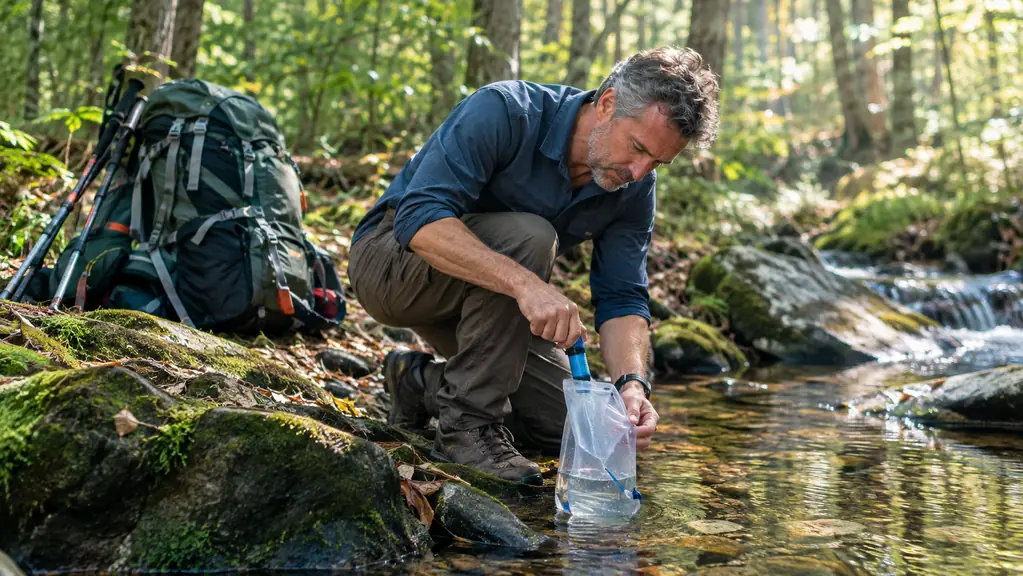
The first time I used my Sawyer Squeeze, I did everything wrong. I filled the pouch from a silty creek on the Sheltowee Trace, squeezed too hard, and stood there waiting for the flow rate the box promised. It didn't come. What came was a slow, steady trickle that filled my bottle in about ninety seconds. That's fine, honestly. It's plenty fast for camp. But nobody tells you that before you buy one, and nobody tells you that the flow rate is the least interesting thing about this filter. The interesting parts are the pouches, the maintenance, and the way a three-ounce piece of plastic becomes the most important thing in your pack.
Here's the honest version. I'm Wes, I'm 54, and I've been camping around Kentucky and Tennessee for about twenty years, the last eight of them backpacking. I bought the Sawyer Squeeze last spring after a season of wrestling with a cheap pump filter that left my arms sore and my patience gone. Since then it has filtered every drop of water I've drunk in the backcountry: Red River Gorge, Big South Fork, a week in the Smokies, and a dozen smaller trips in between. This is the review I wish I'd read before I handed over my money, because the things that almost made me give up on the Squeeze in the first month are the same things that made me a believer by the end of the season. It's not a perfect filter. It's the best one for me, and I'll show you exactly why.
The Quick Verdict
The best backcountry filter I've owned, as long as you plan around two weak points: the included pouches wear out, and the flow rate drops as the filter works. Both are fixable, and neither stopped me from trusting it with every drop.
Amazon Check Today's Price →The filter I trust with every drop of backcountry water
A full season of Kentucky and Tennessee trips, and the Sawyer Squeeze is still the first thing in my pack. Check today's price on Amazon and see if it fits how you hike.
Amazon Check Today's Price on Amazon →How I've Used It
For the record, I'm not a thru-hiker and I don't pretend to be. I'm a retired PE teacher who gets out two or three times a season for solo overnight trips, plus a handful of car-camping weekends with my wife Dana. My standard setup is my TETON Sports pack, the Naturehike Cloud-Up 2 tent, a Therm-a-Rest Z Lite pad, and my Black Diamond trekking poles for the left knee that complains on descents. The Sawyer Squeeze lives in a side pocket of the pack where I can reach it without stopping, and it has been on every single trip since I bought it.
That works out to about twenty nights of use across a full season. I've filtered from the clear streams of the Smokies, from tannin-stained creeks in the gorge, and from the muddy edge of a pond at Big South Fork when I was low on options. I've used it the way it's meant to be used, squeezing the pouch, and I've screwed it onto a standard bottle and drunk straight through it. I've also made just about every mistake you can make with it, which is why this review is heavier on warnings than most. A filter that's only tested on perfect mountain streams hasn't really been tested.
The short version of my verdict is easy: the Sawyer Squeeze is the best water filter I've owned, and I'd buy it again tomorrow. The honest version takes longer, because the filter's strengths and its frustrations are the same thing viewed from different angles. It's light, it's simple, and it lasts, but only if you understand how it wants to be treated.
What Nobody Tells You About the Flow Rate
The box says the Squeeze filters fast, and that's true in the best case. When the filter is new, the pouch is full, and you squeeze with real pressure, you get a strong stream. But the best case doesn't last. Every filter slows down as it catches sediment, and the Squeeze slows more than most because it catches a lot. That's the trade you're making for water that's actually clean, and it's a trade I'll make every time. I'd rather wait an extra minute than wonder what I just drank.
Here's the number that matters. On my first trip, with a fresh filter and a full pouch, I timed a 32-ounce fill at just under a minute. By the end of the season, the same fill took closer to two minutes even with regular backflushing. Neither number is a problem when you're camped next to a creek. Both matter when you're tired, it's getting dark, and you just want two liters filtered so you can crawl into your tent. If you're the kind of hiker who likes to filter at camp while dinner cooks, plan for the slower number and you'll never be disappointed.
The fix is simple, and nobody tells you about it: squeeze slower, not harder. A hard squeeze pushes water through faster in the moment, but it packs sediment into the outer fibers and you'll be backflushing twice as often. A steady, moderate squeeze keeps the flow rate more consistent over the life of the filter. I learned that the hard way after a weekend of aggressive squeezing left me with a filter that barely trickled until I flushed it out. Slow hands, clean water, and a filter that lasts years instead of months.
The Pouches Are the Weak Link
Here's what nobody tells you: the filter is the best part of this system, and the included pouches are the worst part. The Squeeze comes with two 32-ounce pouches, and they work fine when they're new. They fill easily from a deep pool, they roll up small, and they squeeze down to almost nothing when they're empty. But they are the first thing to wear out, and they're the reason a lot of people give up on the Squeeze before they learn to love it. If your only experience with this filter is a leaking pouch, you'll never find out how good the filter itself is.
My first pouch developed a pinhole leak along the seam after about six trips. Not a dramatic tear, just a slow weep that soaked my pack pocket and made me wonder why my map was damp. The second pouch is still going, but the cap threads have started to feel loose, and I handle it like it's made of glass. The pouches are also awkward to fill from shallow water. You can't dip them like a bottle; you have to hold them underwater and let the air burp out, which is a balancing act at a low creek. On the Sheltowee Trace in late summer, half the crossings are that shallow.
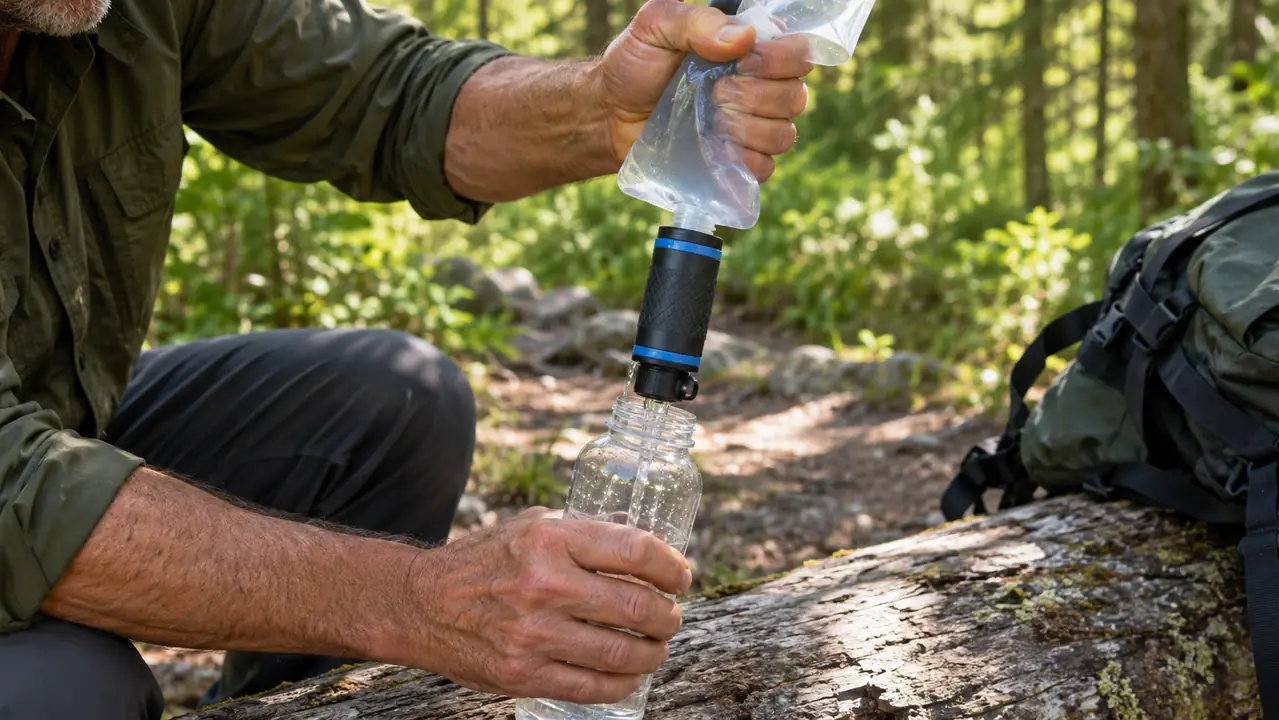
The workaround is the best piece of advice I can give you. The Squeeze uses standard water bottle threads, so it screws directly onto a regular disposable bottle. I carry one clean bottle as my dirty-water scoop, fill it from any pool deep enough to cover the mouth, screw the Squeeze on top, and squeeze the bottle instead of the pouch. It's faster, the bottle is tougher than the pouch, and it's a free upgrade. I still carry one Sawyer pouch as a spare, but the bottle does the daily work. Some folks use the filter inline with a hydration bladder, and that works too, but the bottle method is what I trust.
Backflushing Is Maintenance, Not a Suggestion
The Squeeze comes with a small syringe for backflushing, and for the first month I treated it like a free gift I'd never use. That was a mistake. Backflushing pushes clean water backward through the hollow fibers and clears the sediment that builds up on the outside. Skip it and your flow rate drops until the filter is nearly useless. Do it regularly and the filter keeps performing for years. The difference between a Squeeze that people rave about and a Squeeze that people complain about is almost always the backflushing.
My routine now is boring and reliable. After every trip I backflush with the syringe until the water runs clear. During a trip, if the flow drops noticeably, I backflush once with clean filtered water and it comes right back. The whole process takes about two minutes, and it has saved me from buying a new filter more than once. I keep the syringe in the same pack pocket as the filter so I never have to dig for it, and I rinse the whole setup when I get home.
The other thing nobody tells you: the Squeeze can sit in a pack for months between trips, but it cannot freeze. The hollow fibers are delicate when wet, and ice will crack them from the inside. I keep mine in the house through the winter, and on shoulder-season trips I sleep with it inside my sleeping bag when the temperature drops below freezing. That sounds like overkill until you price a replacement. A filter that costs what this one costs deserves a little bedtime company.
The Carbon Filter Confusion
There's a version of this system that includes a carbon filter, and a lot of buyers assume it removes chemicals and improves taste. It does, but it's a separate purchase, it's not meant for backcountry use, and it doesn't filter viruses. For the creek water I drink in Kentucky and Tennessee, the standard Squeeze is all I need. If you're filtering from a source with agricultural runoff, or you just hate the taste of pond water, the carbon element is worth a look, but know exactly what you're buying. It's an add-on, not an upgrade to the core filter.
And one more honest note. The Squeeze filters bacteria and protozoa, which covers the vast majority of backcountry water in the lower 48. It does not filter viruses, and if you're traveling somewhere with viral contamination, you need a different system or a chemical backup. For my trips, that trade-off is easy to accept. For yours, it's worth thinking about before you buy. The filter can't do everything, and any review that implies it can is doing you a disservice.
The Weight and Packing Reality
Let's talk about the number that actually sold me: three ounces for the filter, and the whole kit with two pouches comes in lighter than the pump filter it replaced. I weighed mine on the kitchen scale before the first trip, and I still remember being surprised. When you're carrying a 65-liter pack with a tent, a pad, and food for three days, three ounces is nothing. It disappears into a side pocket and you forget it's there until you need it.
Packing it is simple, which is part of why I trust it. The filter threads onto a pouch or a bottle, the syringe tucks alongside, and everything lives in one small stuff sack. There's no priming, no pumping, no waiting for chemicals to work. Fill, squeeze, drink. That simplicity is the real reason I reach for it every trip, and it's the reason I've talked more than one friend into buying one.
What I Liked
- Filters fast enough for camp use and weighs almost nothing
- Backflushable, so it lasts for years instead of a season
- Standard bottle threads mean you can ditch the pouches
- No moving parts, nothing to prime, nothing to pump
- The filter I've trusted with every drop for a full season
Where It Falls Short
- The included pouches wear out and leak over time
- Flow rate drops as the filter catches sediment, and you have to stay on top of backflushing
- Freezing destroys it, so cold-weather trips need extra care
- No virus protection, and the carbon element is a separate purchase
By the end of the season, a 32-ounce fill that took under a minute when the filter was new took closer to two, and a two-minute backflush brought it right back.
Who This Is For
Buy the Sawyer Squeeze if you're a weekend backpacker like me who wants one filter that works everywhere, weighs almost nothing, and won't die at the end of the season. It's perfect for the Red River Gorge and Sheltowee Trace crowd, for the Smokies, for anyone filtering from streams and springs where bacteria and protozoa are the real risks. If you're willing to spend ten minutes learning the backflush routine and you'll carry a spare bottle to use as a scoop, this filter will take care of you for years. That's not a marketing promise, that's what a season of use looks like.
It's also the right call if you want to buy once and maintain instead of replace. The Squeeze isn't the cheapest filter on the shelf, but it's one of the few you can bring back to life with a syringe, and that math works out fast if you get out more than a couple of times a season. The pouches will wear out, sure. The filter itself just keeps going.
Who Should Skip It
Skip the Squeeze if you want the fastest possible flow with zero maintenance. The Katadyn BeFree filters faster out of the box and needs no backflushing, but it also clogs permanently when it's done, and you replace the whole thing. That's the real trade-off: the BeFree is easier for a season, the Squeeze is cheaper over five years. If you only filter water a few weekends a year, the easier filter might genuinely be the better buy, and I'd tell you the same thing in person.
Also skip it if you filter from silty, muddy water every time. The Squeeze will handle it, but you'll be backflushing constantly, and letting the water settle first becomes part of the routine. And if you camp mostly in deep winter, the freeze risk is a genuine pain. There are filters built for cold weather, and the Squeeze isn't one of them. For everyone else, it's the filter I'd buy again tomorrow.
Still deciding? The Squeeze is the filter I reach for on every trip
After a full season of Kentucky and Tennessee water, the Sawyer Squeeze is still the first thing in my pack. Check today's price on Amazon and see if it's right for your setup.
Amazon Check Today's Price on Amazon →