
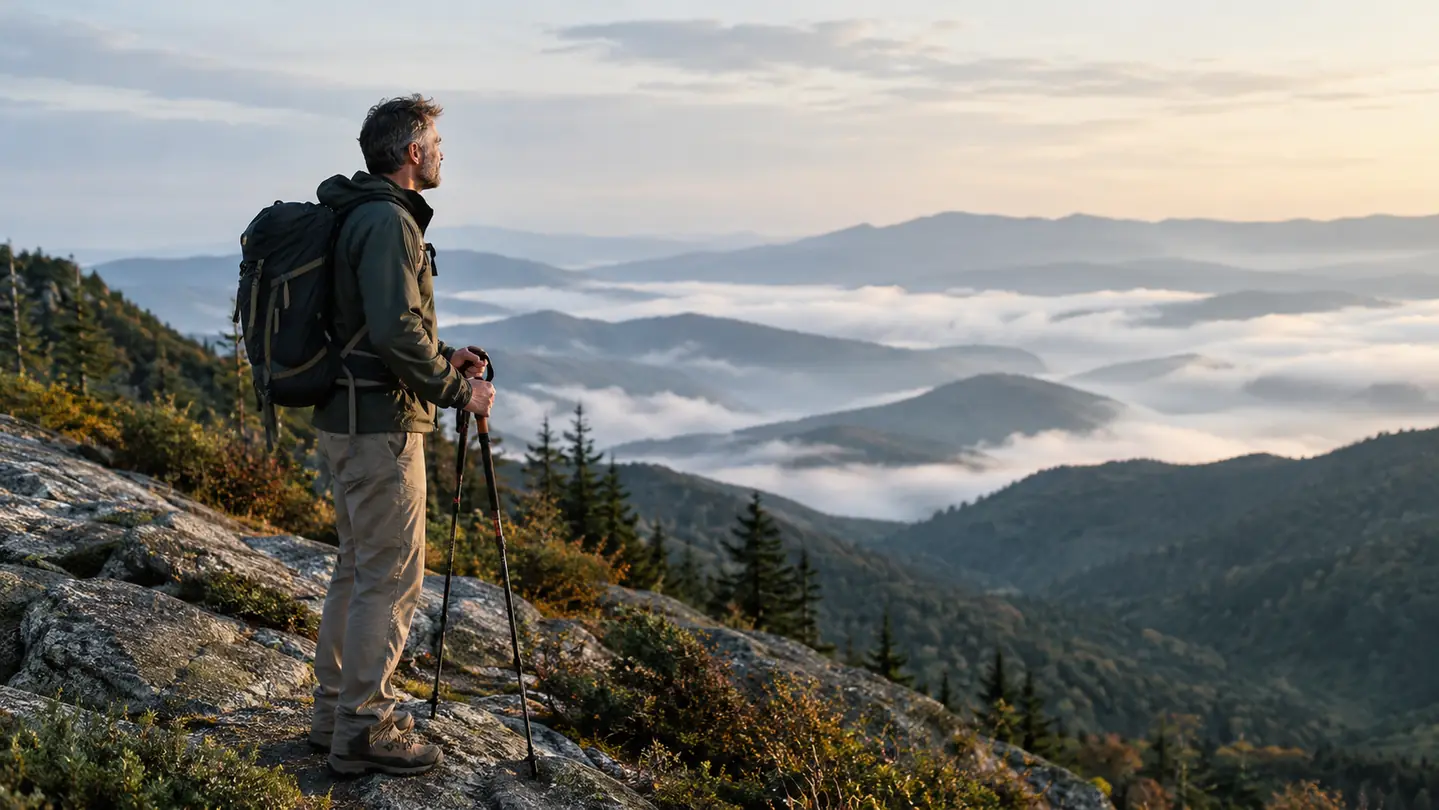
Two years ago I came off the Sheltowee Trace with a left knee that sounded like gravel in a coffee can. I was 52, I'd been hiking for twenty years, and I'd told myself the knee was just the price of getting older. I tried everything except the obvious fix. I babied the knee on descents, took the long way around every rock step, and once I bought a cheap pair of poles from the big-box store that folded on me halfway down a steep pitch. What I did not do was buy a real pair of trekking poles.
That changed last spring when I picked up the BLACK DIAMOND Trail trekking poles. I'm Wes Harlan, a retired PE teacher from Louisville, Kentucky, and I've now spent a full season with them on Red River Gorge, Big South Fork, and a week in the Smokies. My left knee still talks to me on long descents, but it no longer runs the trip. Here are the ten reasons trekking poles save your knees, in the order I noticed them on the trail.
Your knees are doing all the braking right now.
A pair of poles hands some of that job to your arms. The BLACK DIAMOND Trail poles are the pair I've carried all season, and they live in the back of my 2016 Subaru Outback so I never leave a trailhead without them.
Amazon Check Today's Price on Amazon →Descents go from crashes to controlled steps.
A downhill step with no poles is a controlled fall. Your quadriceps lower your whole body weight, plus a pack, with every single stride. On a long descent that adds up to hundreds of hard impacts per mile. With poles, you plant, you load the shaft, and your arms take a share of the braking. The first time I dropped two thousand feet into the Gorge with the Trail poles, my knee felt the difference by the bottom. It felt like I'd handed a third of the work to somebody else.
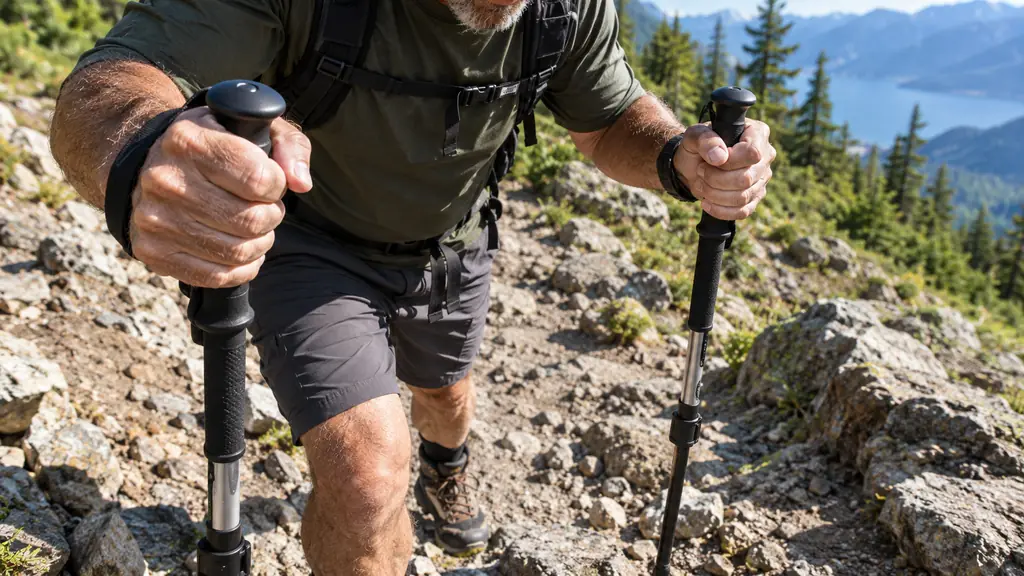
Four contact points beat two.
Two legs and two poles means four points of contact with the trail. Every pound of force that goes through a pole is a pound that does not go through a knee. With my TETON Sports Explorer 65L packed for an overnight, that math matters. I measured nothing scientifically, but I felt it: the same weight, the same distance, and a knee that was still talking to me at the end instead of yelling.
Aluminum flexes before your knee does.
The BLACK DIAMOND Trail poles are aluminum, and that is a feature, not a compromise. Carbon poles are lighter, but they are also stiffer and a lot more expensive. Aluminum gives a little, and that little bit of give soaks up the sharp edge of every planting. On rocky trail, which is most of Kentucky, I would rather have a shaft that bends a little than a joint that takes the full hit.
They force a rhythm that protects your form.
Thirty years of teaching PE taught me that form beats effort. Poles give you a cadence. Plant, step, plant, step. When your hands are busy, you stop taking those long lunging steps that hammer a knee. I noticed it on the first mile of a climb: with poles I was taking shorter, steadier steps, the kind I would tell a kid in gym class to take. The knee liked it. The back liked it too.
Downhill braking is where the knee gets saved.
Going down is the hard part, and it is the part most people never plan for. Every step is your thigh muscle lowering your body like a slow elevator. Do that for two thousand feet and the muscle burns out, which is when the knee starts taking over. Poles hand the braking to your arms. I plant ahead, load the pole, and let my arms do the lowering. My left knee, the cranky one, gets maybe half the work it used to.
They keep you from wrecking the good knee.
Here is what nobody tells you about a bad knee. You compensate. You shift weight to the good side, and before long the good knee is the one complaining. Poles let me keep my weight centered. I do not have to choose which knee to protect, because both of them are sharing the load with my arms. That alone was worth the price of the pair to me.
Wet rock and stream crossings stop being a gamble.
Kentucky trails after a rain are slick. Mossy rock in the Gorge turns a simple crossing into a decision. A slip that would twist a knee or pop a hip gets caught by a planted pole. I crossed creeks this season that I would have waded around last year. The poles did not make me graceful, but they made me steady, and steady is what saves joints.
The morning after is the real test.
The true measure of a hiking day is not how you feel at the trailhead. It is how you feel at 6 a.m. the next day. I used to wake up after a twelve-mile day and need ten minutes before the stairs worked. This season, with the Trail poles, it is more like two minutes. No swelling, no stiffness that makes me walk like a robot to the coffee maker. That is the reason I reach for them every single time.
They save your legs for the downhill.
Using poles on the climb means your legs arrive at the descent with something left. Pushing uphill with your arms is free energy. It does not cost you knee life. So I push on the way up, save the quads, and have them ready for the braking on the way down. It is the same trip, same pack, same distance, but the hard part comes last and I am still fresh enough to handle it.
They are light enough to actually carry.
The best knee-saving gear in the world is useless if it stays in the Subaru. The BLACK DIAMOND Trail poles are light, and that is the whole trick. At under a pound and a half for the pair, I do not think about them. They ride on the outside of my pack, they come out at the first steep pitch, and they go back without a fuss. Four point six stars from over five hundred reviews on Amazon, and I get why. Simple, light, and they do the job.
What I'd Skip
Not everyone needs trekking poles, and I would not pretend otherwise. If you only hike flat, groomed trails, or you spend your outdoor time on a paved path, save your money. My knees never complained on the easy loop at the county park. I would also skip the expensive carbon poles unless you are counting ounces on a thru-hike. The aluminum Trail pair does the job for a weekend backpacker. What I would not skip is a few minutes of practice. Plant the pole before you step, not beside you. Ten minutes on flat ground will save you a lot of awkwardness on the first real descent.
I used to wake up after a twelve-mile day and need ten minutes before the stairs worked. This season, with the Trail poles, it is more like two.
One season in, my left knee still hikes.
That is the whole review. If you have a knee that complains on the way down, the BLACK DIAMOND Trail poles are where I would put my money. They are light enough to carry, simple enough to trust, and they have kept me on the trail all season.
Amazon Check Today's Price on Amazon →