
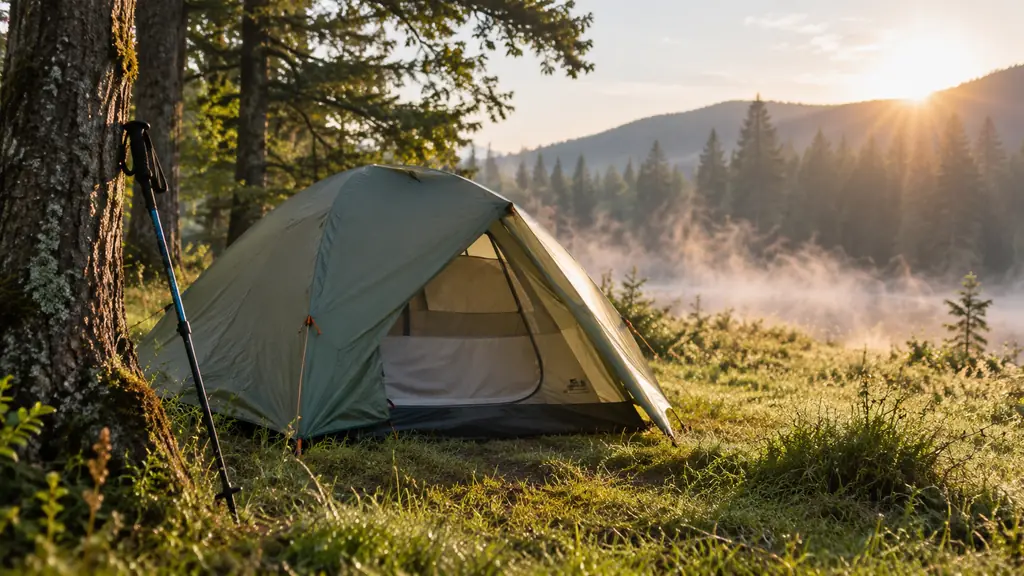
The first thing I do when I pick up any piece of backpacking gear is the math. I'm 54, my left knee complains on every descent, and my lower back lets me know the moment a pack is loaded wrong. So when I tell you the Naturehike Cloud-Up 2 has been my solo tent for a full season of weekend trips, I mean I weighed it against every other pound in my pack before it earned that spot.
I bought the Cloud-Up 2 last spring after one too many nights in the cheap big-box tent I'd been carrying for years. That old tent worked, in the sense that it kept rain off me, but it was heavy, it sagged on me, and setting it up felt like a wrestling match. I wanted something lighter that I could pitch in the dark after a long day on the Sheltowee Trace. The Naturehike came in at about half the weight of what I had, it packs down small enough to lie flat against my TETON pack, and the footprint is included, which I never had before.
The Quick Verdict
The best value in a freestanding two-person tent I've used in eight years of backpacking. It's not the lightest or the most storm-proof tent you can buy, but at this weight and this price, nothing else I've tried does the whole job as well.
Amazon Check Today's Price →A full season in, this is the tent I grab for solo weekends
I've slept in the Cloud-Up 2 on more than twenty nights across Kentucky and Tennessee, in rain, wind, and one genuinely cold October night. For the weight and the packed size, I haven't found anything that beats it for the money.
Amazon Check Today's Price on Amazon →How I've Used It
I keep a log of every trip, mostly so I can remember which campsites had good water. This season the Cloud-Up 2 went on eleven nights in Kentucky and Tennessee: three trips to Red River Gorge, two weekends on the Sheltowee Trace, one overnight at Big South Fork, and a handful of quick one-nighters within an hour of home. That's not a thru-hike, and I'm not going to pretend it is. It's a normal season for a weekend backpacker, which is exactly who this tent is for.
Most of those nights were solo. Dana comes car camping with me a few times a year, but she doesn't backpack, so the Cloud-Up 2 has mostly been a one-person shelter with room to spare. I've also used it as a two-person tent twice, once with a friend at Red River Gorge. It fits two adults on two sleeping pads, snug but honest, and the two doors mean nobody crawls over anybody at 2 a.m.
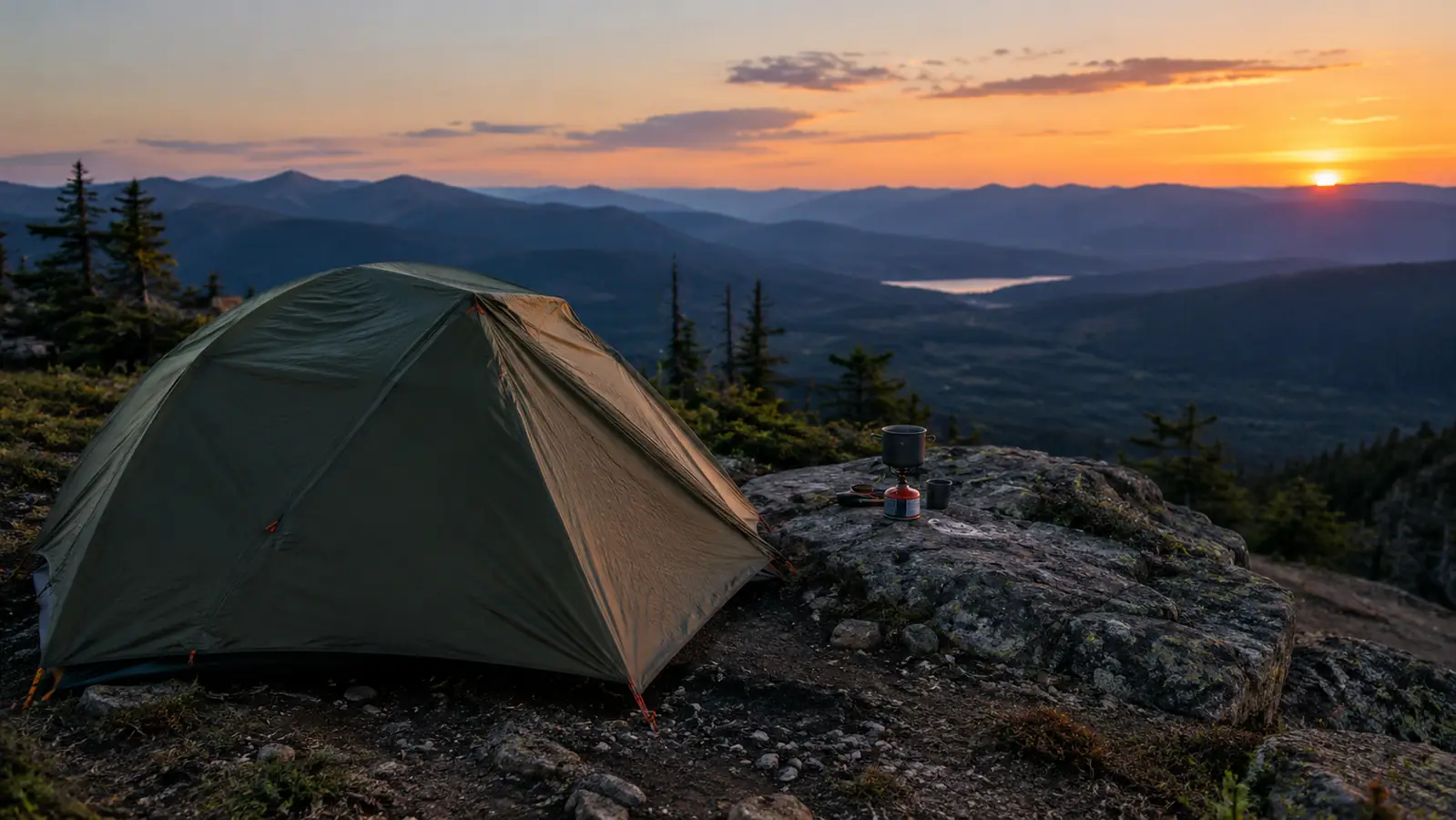
I pitched it on packed gravel, on pine needles, on a slab of rock at Big South Fork, and once on a sloped site I should have walked away from. It went up in rain, in wind, and in the dark. That's the testing that matters to me, more than any spec sheet.
The one trip it didn't go on was our week in the Smokies, because that's a car-camping trip with Dana and the big family tent. I thought about bringing it anyway, but the family tent has room for the two of us and the chairs, and the Cloud-Up 2 stayed home. That's not a knock on the tent. It's just the right tool for the right trip.
What the Weight Actually Feels Like
The number that sold me was the weight. My old tent was something like five and a half pounds with the poles and stakes, and I felt every ounce of it by mile three. The Cloud-Up 2 comes in at a little over two and a half pounds with the footprint included, which matters more to me than any other number on the box.
My back is the reason. A pack that's two pounds lighter on the bottom, where the tent rides, is a pack that stops pulling on my lower back by the end of the day. I carry the Cloud-Up 2 vertically against the back panel of my TETON Explorer 65L, and I honestly don't think about it once I'm moving. That's the whole point of lighter gear: you stop noticing it.
I'll be straight about what this weight doesn't include. The poles are aluminum, and they feel solid, but this is not an ultralight tent. It's a lightweight tent at a reasonable weight, and there's a difference. If you're counting grams and trimming your toothbrush handle, this isn't the tent for you. If you're a normal weekend backpacker who wants to drop three pounds off your back without taking out a second mortgage on your gear budget, this is very much the tent for you.
Setup, Take Down, and the Footprint
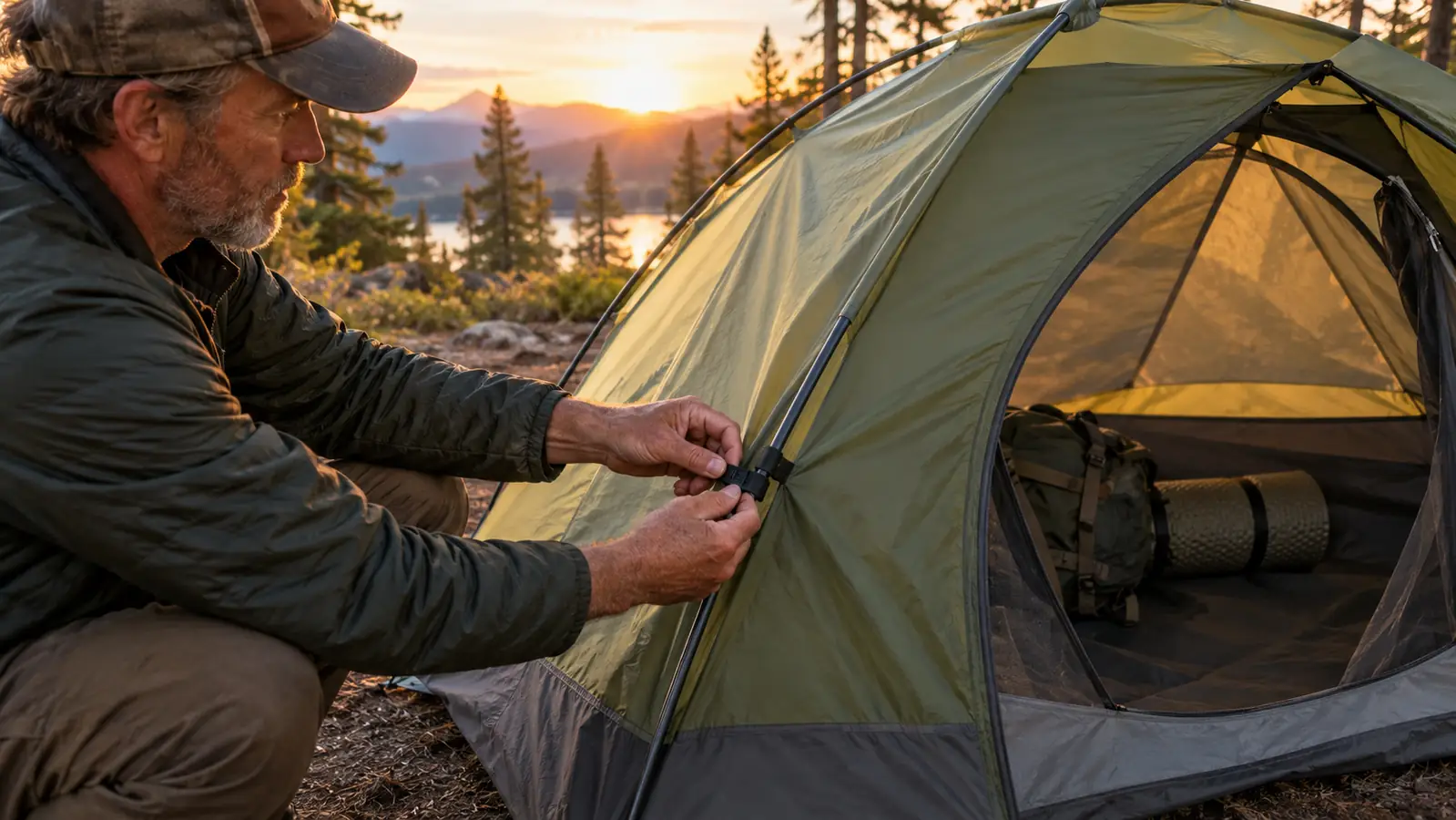
Setup is where a tent earns its keep for me. The Naturehike Cloud-Up 2 is freestanding, which means the poles hold it up on their own before you stake a single corner. I clip the inner tent to the poles, drape the fly over the top, and I'm done in about eight minutes the first time and closer to five now that I've done it twenty times. The poles are color-coded, the clips are forgiving, and I've never once had to read the instructions in the field.
The footprint is the detail I didn't know I needed. It clips into the bottom of the tent, so the whole thing pitches as one unit. On the rocky sites at Big South Fork, that footprint saved the floor more than once. I used to lay out a piece of cheap plastic sheeting under my old tent, and it slid around and never stayed put. This one is cut to fit, it clips in, and it means the tent floor doesn't touch the ground at all.
Take-down is just as quick, with one honest complaint: the tent packs tighter than it came out of the stuff sack the first few times. The fabric relaxes after a season, but early on I had to roll it carefully to get it back in the bag. It's a small thing, and it got easier, but I'd rather tell you now than have you fight it in a parking lot.
Rain, Wind, and One Cold October Night
The real test came in late October, up on the Sheltowee Trace. The forecast said a chance of showers. What rolled in was a steady rain that started around midnight and a wind that had the fly snapping like a flag. I woke up at 3 a.m. and ran my hand along the inside of the fly. Dry. I checked the corners of the floor. Dry. I went back to sleep and didn't think about it again. That's the highest praise I can give a tent: I stopped thinking about it.
Condensation is the tradeoff you should know about. On cool, still nights, moisture builds up on the inside of the fly, and if you brush against it, you'll feel it. That's true of most budget double-wall tents, and the Naturehike Cloud-Up 2 is no exception. The fix is the two doors. I leave one cracked open on cool nights, and the cross-ventilation handles most of it. On warm nights I sleep with both doors open and the fly still overhead, and it's as breezy as a tent can be.
The wind performance surprised me. I expected a light tent to flap and shiver in a gust, and it does move a little, but the shape sheds wind better than I thought it would. I've never had a pole bend or a stake pull on this tent, and I've had it in some honest wind. I still pick a sheltered site when I can, because that's just good sense, but I don't worry about this tent the way I worried about my last one.
What I Gave Up to Get This Light
I'd be lying if I said the Cloud-Up 2 is as roomy as the tent it replaced. It's not. My old tent was a palace by comparison, with steep walls and enough floor space to spread out all my gear. The Cloud-Up 2 is a more modest shape, and the walls slope in more than I'd like when I'm sitting up. I've learned to keep my gear in the vestibules and my body in the tent, and that works fine.
The second thing I gave up is a little bit of storm security. A heavier tent with a beefier pole set is going to feel more bombproof in a real blow. I've never been in weather that scared me in this tent, but I also don't take it above treeline in winter, and I wouldn't. It's a three-season tent, full stop. Know that going in and you'll never be disappointed.
The third tradeoff is the one I keep coming back to, because it's the one that matters: I stopped leaving the tent behind. My old tent was heavy enough that I'd talk myself out of an overnight trip on a Friday afternoon, or I'd car camp instead of backpack because packing the tent felt like a chore. Now the Cloud-Up 2 lives in the bottom of my pack, ready to go. A tent you actually take is worth more than a tent that's technically better but stays in the garage.
The Details That Matter After Twenty Nights
After a season, the small stuff tells you what a tent is really made of. The zippers on the Naturehike Cloud-Up 2 are still smooth, and I have never once had to wrestle with the main door. The stakes are the aluminum kind with a hook at the top, and they've stayed straight, which is more than I can say for the steel pins that came with my old tent. The pole clips are still snug, and the guy lines have held their tension.
One thing I'll note: the stakes that come with it are light, and in soft ground after rain they can pull if you don't seat them at an angle. I replaced the four corner stakes with heavier ones I had on hand and kept the originals for the guy lines. That's a few minutes of work, and it made the tent noticeably more solid in a blow.
The fabric has held up well. I've had it on gravel and rock, and the floor, protected by the footprint, shows almost no wear. The fly still sheds water the way it did on night one. And the stuff sack is genuinely usable, not the flimsy bag you get with cheap tents. The whole tent, poles, stakes, and footprint, fits in one bundle that straps to the outside of my pack. That's the difference between a tent I take and a tent I leave at home.
I measured the packed size once out of curiosity: it's roughly the size of a large loaf of bread, and it straps vertically to the outside of my pack. On trail, that means my pack's internal volume stays free for food and water.
What I Liked
- Freestanding design goes up in about five minutes, even in the dark
- Included footprint clips in and protects the floor on rocky sites
- Two doors and two vestibules for real ventilation and easy entry
- Roughly half the weight of the tent it replaced, and I feel it in my back
- Held up through a full season of rain, wind, and gravel sites
Where It Falls Short
- Condensation on the fly on cool, still nights if you don't crack a door
- The stock stakes are light and can pull in soft ground after rain
- Two adults fit, but it's snug; really a roomy one-person tent at heart
I woke up at 3 a.m., ran my hand along the inside of the fly, and it was dry. That's the highest praise I can give a tent: I stopped thinking about it.
Who This Is For
This tent is for the weekend backpacker who wants to drop weight without dropping their budget. It's for the solo hiker who wants a two-person tent for the extra room, the person who camps in the Southeast where summer nights are warm and ventilation matters, and the car camper who wants one tent that does double duty. If you're newer to backpacking and you want a freestanding tent that's forgiving to set up and easy to live with, this is the one I'd point you to. And if you're still deciding whether a freestanding tent is worth it at all, I've laid out the reasons in my article on why freestanding backpacking tents are worth it.
Who Should Skip It
If you're a thru-hiker counting grams, or you regularly camp above treeline in serious wind, spend more on a dedicated ultralight or four-season tent. If you're tall and broad-shouldered, the interior will feel tight, and you'll probably want the Naturehike Cloud-Up 3 or a different tent altogether. If you want a roomier two-person tent and you don't mind carrying more weight, the Kelty Grand Mesa is worth a look, and I've compared the two side by side. And if you expect a tent to be completely condensation-free on cold, still nights, no budget double-wall tent is going to deliver that. Know what you're buying, and this tent will treat you right.
My full-season verdict: buy the Cloud-Up 2, spend the savings on trail miles
More than twenty nights in, this is the tent I reach for every time. It's light, it's easy, and it's kept me dry in weather I didn't plan for. If that sounds like your kind of weekend, check the current price on Amazon.
Amazon Check Today's Price on Amazon →