
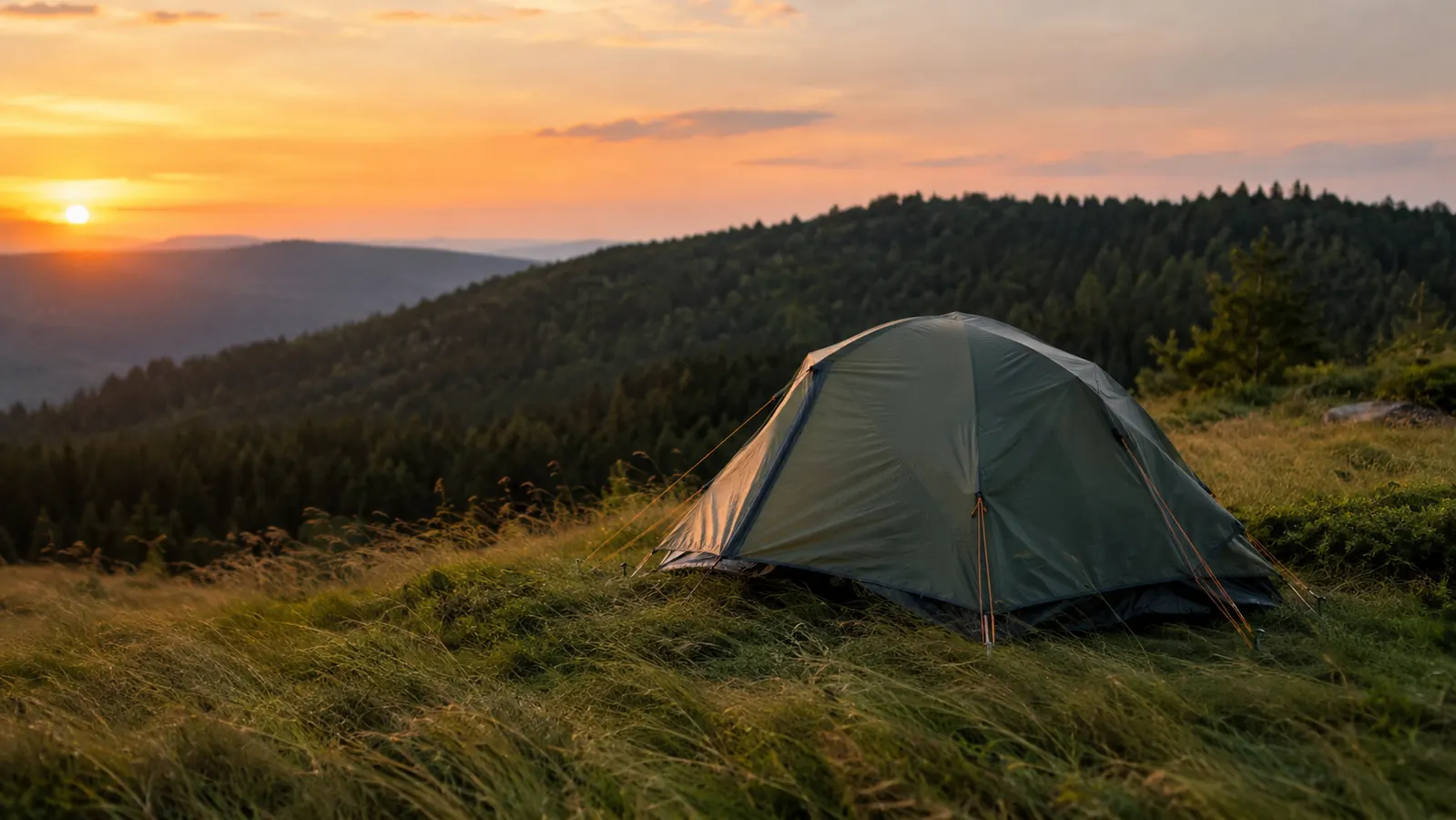
The wind hit me at about 3,400 feet on the Sheltowee Trace, right where the trail leaves the trees and crosses an open ridge. I had the Naturehike Cloud-Up 2 out of the stuff sack, poles in hand, and a gust grabbed the fly like a sail. If you have ever tried to pitch a backpacking tent in wind, you know the next few minutes: wrestling nylon, chasing a pole that rolled downhill, and saying things you would not say in front of your old students. I have done this enough times now, mostly on exposed Kentucky ridgelines and one memorable week in the Smokies, that I have a method. It is not fancy. It works.
Stop fighting the wind. Pitch the Naturehike Cloud-Up 2 the right way.
The same tent I have used for a full season of solo trips, now with a method that gets it up in under five minutes even in a gusty ridgeline wind.
Amazon Check Today's Price on Amazon →Step 1: Pick the spot before you unpack anything
Wind is a site problem before it is a tent problem. In a couple of minutes of looking, you can save yourself a miserable night. I want three things: a slight dip or depression, a natural windbreak, and ground that takes a stake. A hollow the size of a car is enough to drop the wind speed at tent level by a lot, and a clump of pines or a big rock on the windward side does the same. Avoid the top of a rise, the mouth of a saddle, and anywhere near a single tall tree that will dump branches on you in a blow.
The second half of site choice is orientation. Point the narrow end of the Naturehike Cloud-Up 2 into the wind, not the broad side. The tent is a dome, so it sheds wind best when the smallest face takes the hit. I also look at the ground for a slight slope and sleep with my head uphill. That has nothing to do with wind and everything to do with not waking up with my face in the netting.
One more thing: if the ground is hard, rocky, or frozen, scout for roots and rocks before you commit. You are about to spend a lot of effort on stakes, and the worst feeling is a stake that hits a rock on the third tap and bends. I carry a lightweight stake that handles most ground, but I have still bent one on a hidden root. Look first, pound second. Last October at Big South Fork, I watched a couple pitch right on the crown of a bald knob because the view was good. By midnight the wind had shifted and their fly was wrapped around a rhododendron. I was in a hollow about forty yards down the slope and woke up once all night. The view is nice. Sleep is nicer.
Step 2: Stake the windward corners before you raise the poles
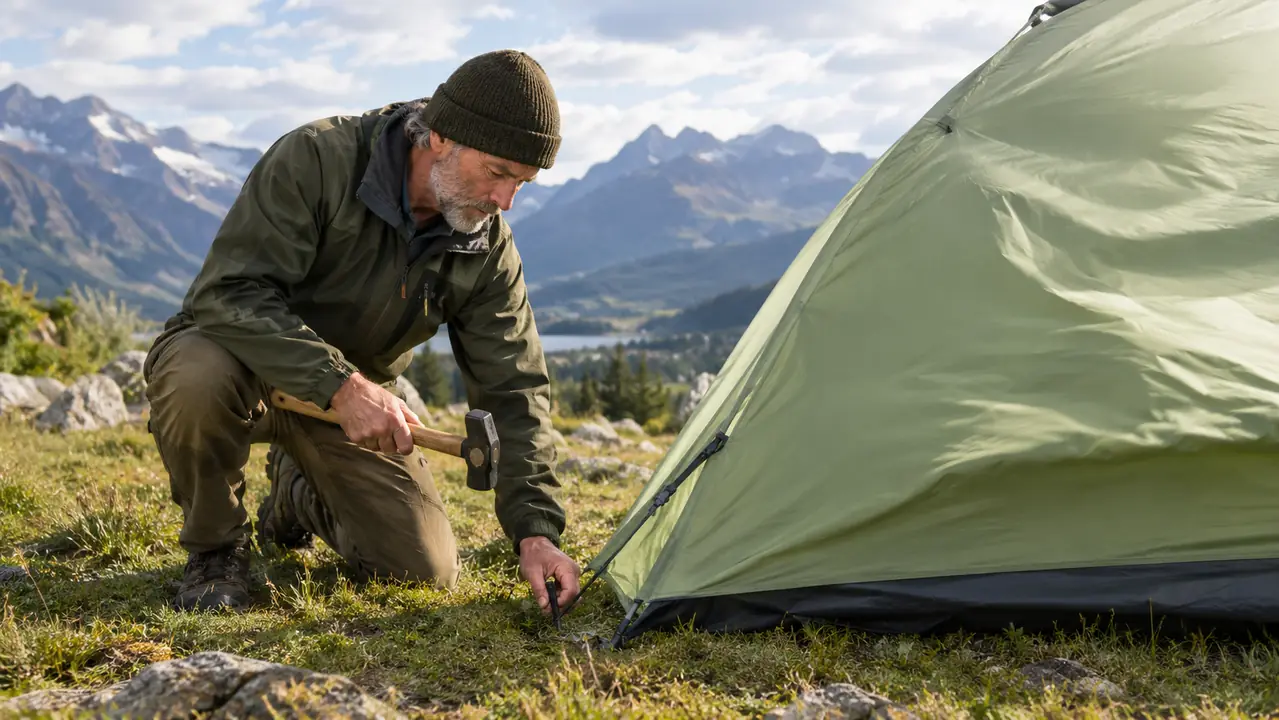
The order of operations is what separates a calm-day pitch from a windy-day pitch. On a calm day, you can raise the poles first and stake after. In wind, the tent becomes a kite the moment the poles go in. So I stake the windward corners first, while the tent is still flat on the ground and the poles are still in their sleeves or clips.
Lay the Naturehike Cloud-Up 2 out with the windward side facing the wind. Take the two windward corner stakes and drive them at an angle, leaning away from the tent, so they resist the pull of the fabric. I use the stakes that came with the tent for most ground, and I replace them only when I know I am heading into rocky or sandy soil. Angle matters more than people think: a straight-down stake pulls out of soft ground, while a 45-degree stake holds like an anchor.
Once the windward corners are in, I raise the poles. With the corners pinned, the tent cannot blow away while I am getting the poles seated. If the gusts are really bad, I also put one hand on the center of the pole arch while I clip the other side. It is a small thing, but it stops the whole structure from torquing sideways and popping a corner out. Late last March on the Sheltowee Trace, a gust hit while I was seating the second pole. The windward corners held the tent flat, and it just stood there and took it. That is the whole point of corners first. The only time a pole has popped out of its grommet was the one time I skipped this step and raised the poles before staking.
Step 3: Get the ridgeline taut before you stake anything else
The ridgeline is the spine of the tent. If it is loose, the whole tent flops and the fly slaps all night. If it is taut, the tent holds its shape and the wind rolls over it. So after the poles are up, I go to the head end and pull the ridgeline tight, then stake that corner. Then I do the same at the foot end. Two corners, one ridge, done.
On the Naturehike Cloud-Up 2, the ridgeline is easy to find: it is the seam that runs from the head end to the foot end along the top. I pull it until the fabric has no sag, then I stake. I do not overdo it. A ridgeline that is too tight can distort the pole geometry and make the tent harder to pitch, especially in cold weather when the fabric is stiff. I aim for firm, not guitar-string.
This is also the moment to check the pole clips and the pole sleeves. On a windy pitch, a clip can pop off a pole while you are moving around the tent. I run a hand along each pole, seating every clip, before I move on to the next stake. It takes thirty seconds and it saves you from a midnight repair in the dark.
Step 4: Stake the corners in a cross pattern, then add the guylines
With the windward corners and the ridgeline done, I stake the remaining corners in a cross pattern: the leeward corner opposite the first windward corner, then the other leeward corner. This keeps the tent square and prevents the fabric from twisting as you tension it. If you stake all the corners on one side first, the tent pulls out of shape and the last corner never lines up with its loop.
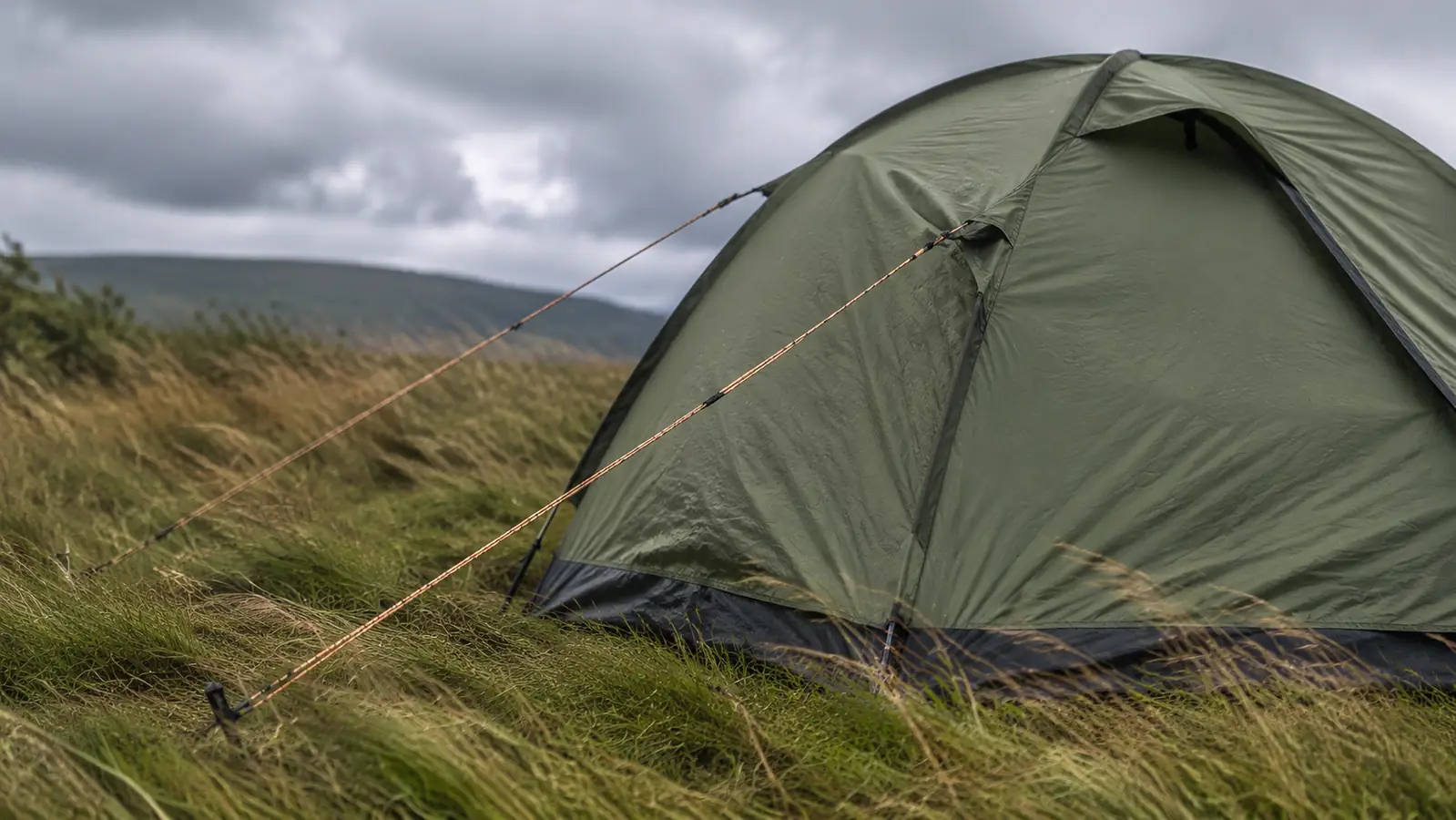
After the corners, I add the guylines. The Naturehike Cloud-Up 2 has guy points on the fly, and I use every one of them in wind. The two on the windward side get staked at about 45 degrees off the corner, not straight out. That angle spreads the load and keeps the fly from flapping. The rear guyline gets a stake straight back, which holds the fly off the inner tent and keeps condensation off my sleeping bag. On the windy week in the Smokies last May, I skipped the rear guyline one night because I was tired and the forecast said calm. It was not calm. The fly slapped the inner tent all night, and my sleeping bag was damp by morning. I have not skipped it since.
I tension the guylines until the fly is just off the inner tent. Too loose and the fly slaps. Too tight and you pull the pole geometry out of shape. The right tension is the one where the fly does not move when you push on it with a finger. If you can make a dent, tighten it. If the fly is pulling the pole arch sideways, loosen it.
Step 5: Load the tent against the wind and check everything before dark
The last step is the one most people skip. I put my pack inside the tent, against the windward wall, and I set my boots and water filter beside it. That weight holds the tent down from the inside and stops the floor from lifting in a gust. It also means my gear is out of the weather and I am not chasing a pack across a campsite at midnight.
Then I do a full lap of the tent before dark. I check every stake, every guyline, every clip. I look for fabric that is rubbing on a pole, a stake that has pulled partway out of the ground, a guyline that has slipped off its hook. On a windy night, a loose stake does not fix itself. It gets looser. I have woken up at 2 AM to a tent that sounded like a drum and found a single corner stake that had worked itself out of the dirt. Now I check before the sun goes down, and I check once more if I get up to pee. Two seasons ago at Red River Gorge, the wind came up fast around nine at night, and I watched a stake I had driven six inches into packed dirt work itself loose over about an hour. I re-drove it at a steeper angle, and it held until morning. Now I carry a flat rock in my pack for hammering stakes into ground that fights back.
One more habit: I keep the door zipped on the windward side and I enter and exit on the leeward side. It sounds obvious, but a door that faces the wind turns your tent into a scoop every time you open it. I also zip the vestibule closed before I go to sleep. A flapping vestibule is the loudest sound in a windy camp, and it is the easiest one to prevent.
What Else Helps
Two pieces of gear make a windy pitch easier. First, a set of extra guylines with a couple of lightweight stakes. The Naturehike Cloud-Up 2 comes with what it comes with, and that is fine for most nights. But on an exposed ridge, extra guylines on the windward side turn a flapping tent into a solid one. I carry four extra stakes and about twenty feet of line, and I have used them on every windy trip this season.
Second, my Therm-a-Rest Z Lite Sol pad does double duty as a windbreak. I lay it against the windward wall of the tent when I am inside, which cuts the draft and keeps the floor from lifting. It is a small trick, but it has made the difference between a sleepless night and a good one on more than one ridge. If you are looking for a reason to carry a foam pad instead of an inflatable one, this is it.
On a windy night, a loose stake does not fix itself. It gets looser. I check every stake before dark, and I check once more if I get up to pee.
The Bottom Line
The Naturehike Cloud-Up 2 is a good tent for a windy pitch because it is a simple dome with a full fly and a solid stake layout. It is not the lightest tent I have carried, but it is light enough at about three and a half pounds, and it pitches fast once you know the order. I have used it for a full season of solo trips, from the Red River Gorge to the Smokies, and it has never let a gust get the better of me.
The method is the same for any dome tent, honestly. Site first, windward corners second, ridgeline third, cross pattern fourth, guylines and loading fifth. If you do those five things in that order, you will sleep through wind that sends your neighbors' tents flapping. I have. And on the nights when the wind is really howling, I am glad I spent the extra two minutes on the guylines.
Pitch it right once, and you will sleep through wind that sends other tents flapping.
The Naturehike Cloud-Up 2 is the tent I reach for on every windy solo trip. See today's price and check the current listing.
Amazon Check Today's Price on Amazon →