
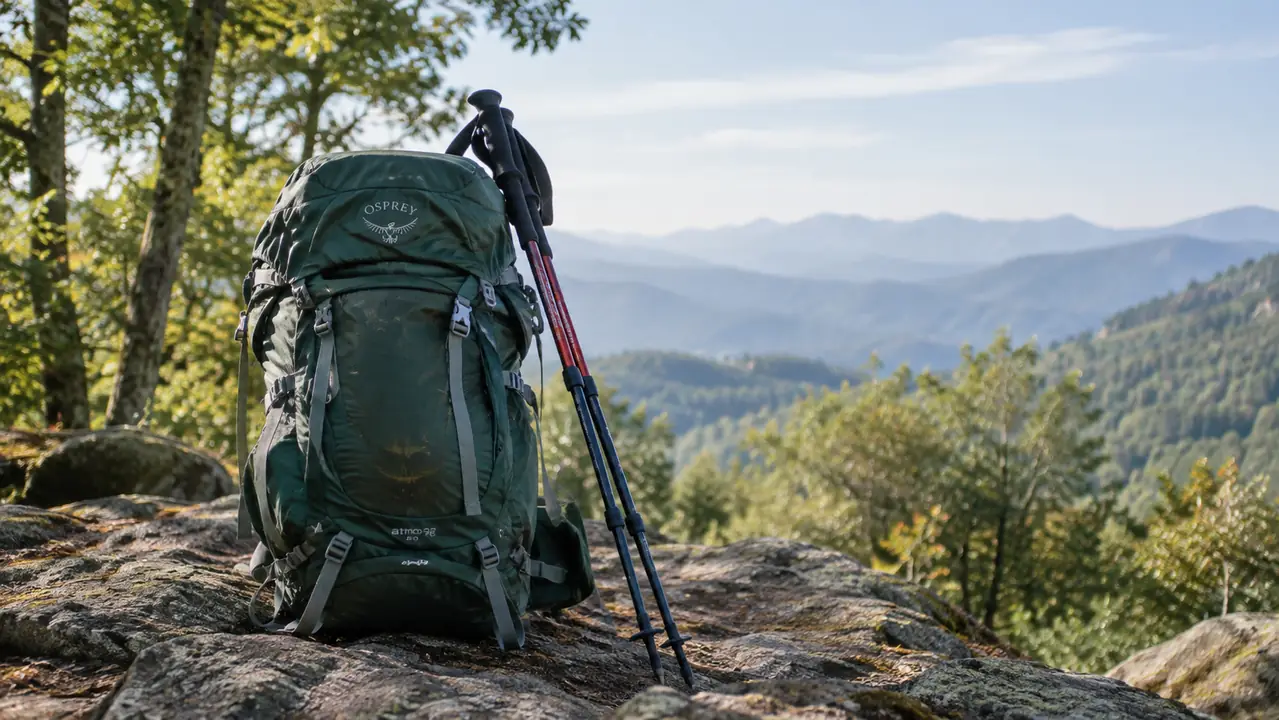
I will be honest with you. When the TETON Sports Explorer 65L showed up on my porch last April, I had already decided I would probably send it back. I have backpacked for eight years with a pack that cost less than a good dinner, and my lower back has been billing me for it ever since. I am Wes Harlan, 54, a retired PE teacher from outside Louisville, and I judge a pack the way I used to judge a freshman lineman: by how it holds up after the first hour, not how it looks in the parking lot.
This is not a review written from a living room. I carried the Explorer 65L on seven trips this season. Solo overnights in Red River Gorge, a three-day stretch on the Sheltowee Trace, a wet weekend at Big South Fork, and a full week in the Smokies with my wife Dana, who does not backpack but has strong opinions about how long it takes me to break camp. The pack also rode in the back of my 2016 Subaru Outback more times than I can count, which matters more than you might think.
The Quick Verdict
A heavy pack that earns its weight if you need a real frame on a real budget. It carried 42 pounds through a week of Smokies rain without breaking my back, and I would change three things about it.
Amazon Check Today's Price →The 65-liter pack that carried 42 pounds through a week of Smokies rain
That is the short version of what the TETON Sports Explorer 65L did for me this season. The long version, including the three things I would change, is below. If you already know you want one, today's price on Amazon is the easiest part of the decision.
Amazon Check Today's Price on Amazon →How I've Used It
The Explorer 65L was my only backpacking pack from April to October. I did not rotate it with anything else. The heaviest load I gave it was about 42 pounds on the first day of a Smokies loop, when I carried extra water because the forecast lied. The lightest was 24 pounds on a solo overnight in the Gorge. Most trips fell somewhere in the middle, around 32 pounds with food and fuel.
Conditions ranged from a 90-degree afternoon on the Sheltowee Trace to a night at Big South Fork where the temperature dropped to 40 and the rain did not stop for eighteen hours. I want to be clear about that, because a lot of reviews get written in good weather. This pack got rained on, dropped on rocks, leaned against trees, and stuffed into the back of the Outback with a muddy tent. It looks used now. That is the point.
I also want to be clear about my standards. I am not a thru-hiker and I never claim to be. I am a 54-year-old man with a cranky left knee and a lower back that tells me within the first mile whether a pack fits. I take two or three solo overnights a season and one longer trip with Dana along for the car-camping parts. If a pack works for that, it works for a lot of people.
Where the Frame Earns Its Keep
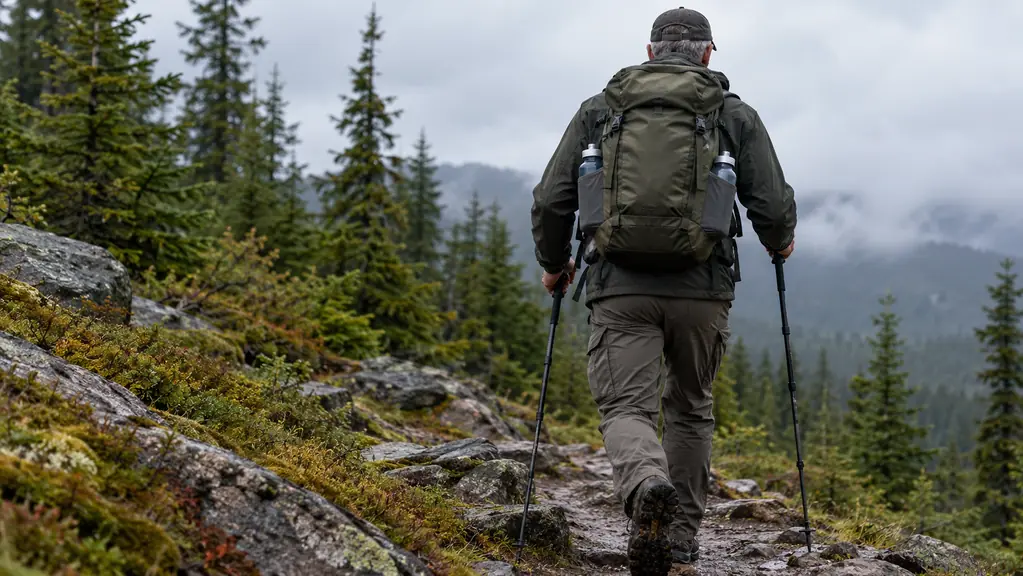
Here is what nobody tells you about the Explorer 65L: the frame is the whole story. The pack has an internal frame with a single aluminum stay on each side, and those stays do the job. When I tightened the hip belt and the load lifters, I could feel the weight move off my shoulders and onto my hips within about ten steps. That transfer is the difference between a pack that fights you and a pack that carries you.
The frame also holds the pack away from your back, which matters more than I expected. On a 90-degree day on the Trace, the airflow channel kept my back from turning into a swamp. That is not a luxury. For a guy with a bad back, a pack that sits against your spine and sweats is a pack that makes you miserable by mile three.
The tradeoff is weight. The pack itself is around four and a half pounds, which is heavy by modern standards. You feel that on the scale at home, and you feel it on the first mile of a climb. What I found is that the weight of the pack buys you a frame that actually works. There are lighter packs with frames that feel like wet cardboard. I would rather carry four and a half pounds of honest frame than three pounds of wishful thinking.
The compression straps are worth a paragraph. They pull the load tight against the frame, which stops the pack from swaying when you are scrambling over rocks. My old pack swayed on every descent, and my left knee paid for it. With the Explorer 65L snugged down, I barely notice the load moving. That is a bigger deal than it sounds.
The Fit: What Nobody Tells You
Fit is where the Explorer 65L asks for patience. The torso length adjusts, which is a feature you usually have to pay a lot more for. But the adjustment is not obvious the first time you do it. I spent twenty minutes in my garage with the owner's manual, and I am a guy who taught equipment use for a living. The hip belt also has a lot of adjustment, and finding the right tension took a few trips, not a few minutes.
Once I had it dialed in, the fit was genuinely good. The load lifters made a bigger difference than I expected. When I pulled them snug, the pack stopped pulling backward on my shoulders. The sternum strap is fine, nothing special. The shoulder straps are comfortable but not plush, which is the honest way to say they are better than the cheap packs and not as cushioned as the premium ones.
The one fit complaint I will stand behind: the hip belt runs a little wide for a lean frame. I am not a small man, and I had to cinch it down further than I expected. If you are built narrow through the hips, try the pack on with a loaded bag before you buy it. That is not a reason to skip it. It is a reason to test it.
The other fit note is the sternum strap height. It slides up and down on a track, which sounds minor, but on a pack the height of the sternum strap changes how the shoulder straps sit. I moved mine up half an inch and the difference was immediate. If something feels off with this pack, fiddle with the small adjustments before you blame the harness.
Comfort Over a Full Season
The real test for me was the Smokies trip in October. Six days, five nights, rain on three of them, and a knee that complains on every descent. I carried the Explorer 65L with the hip belt snug and the load lifters set, and my back felt better on day six than it did on day one. I cannot say that about my old pack, and I cannot say it about every pack I have tried.
The padding held up. The hip belt padding is still firm, the shoulder straps still have their shape, and the lumbar pad did not flatten out the way cheap padding does. The fabric shows trail wear, which I expect. The zippers are still smooth, including the big U-shaped opening that makes packing and unpacking easier than on any pack I have owned.
One thing I noticed over the season: the pack carries better when it is packed the way the designers intended, with the heavy stuff against your back and up high. That sounds obvious, but it is worth saying because the Explorer 65L is forgiving enough that you can pack it badly and still be okay. The first time I packed it badly, I blamed the pack. The second time, I repacked it and the pack was fine.
The shoulder straps broke in nicely over the season. New packs often have stiff straps that dig in at the edges, and the Explorer 65L was no exception for the first few miles. By midsummer the straps had softened and shaped themselves to my shoulders. That is not a feature you will read on the box, but it is a real part of the comfort story.
I carried 42 pounds through a week of Smokies rain and my back felt better on day six than it did on day one. That is the whole review.
What I Would Change
Now the part I promised you. Three things. First, the pack is heavy. Around four and a half pounds is a lot when you are counting ounces, and if you are the kind of hiker who weighs everything, this is not the pack for you. I am not that hiker. I am the hiker who wants a frame that works and a price that does not hurt, and I will trade ounces for both.
Second, the water bottle pockets are fiddly. They hold a standard bottle fine, but getting a bottle back in while wearing the pack takes a contortionist move. I learned to ask Dana to hand me a bottle, or to stop and take the pack off. On a hot day, that is a real annoyance, and I would redesign the pocket angle if I ran the company.
Third, the included rain cover is a nice idea but the attachment is weak. The cover stayed on in the Big South Fork rain, but it flapped loose at the bottom and I had to stop and resecure it twice. It did its job. It just did not do it gracefully. Those are my three honest complaints, and they are all fixable or ignorable, depending on how you hike.
Alternatives I Considered
I looked at the Osprey Atmos before I bought this pack. I will be honest about why I did not buy it: the price. The Atmos is a fine pack, and the suspension is more refined than anything TETON Sports makes. But I could not justify the difference for the way I hike. I am a weekend backpacker, not an expedition guy, and the Explorer 65L does ninety percent of the job at a fraction of the cost.
I also considered going cheaper, because my old pack was the cheapest thing on the shelf and I told myself it was fine. It was not fine. It put weight on my shoulders, it swayed on my hips, and it made every trip worse than it needed to be. The Explorer 65L is the middle path: a real internal frame, real adjustability, and a price that does not require a second mortgage. For my money, that is the sweet spot.
I have not carried the Atmos or the other premium packs, so I am not going to pretend I can compare them on the trail. What I can tell you is what I compared: the Explorer 65L against my old pack, on the same trails, in the same weather. That comparison is not close. The TETON Sports pack won every single trip.
If you are deciding between this pack and a much more expensive one, ask yourself one question: how many nights a year do you actually sleep in the backcountry? For me the answer is somewhere between twelve and eighteen. At that volume, the difference between a good pack and a great pack matters less than the difference between a good pack and a bad one.
What I Liked
- Real internal frame that moves weight off your shoulders and onto your hips
- Adjustable torso length, rare at this price
- Big U-shaped opening that makes packing and unpacking easy
- Comfortable for a full week on the trail, even at 42 pounds
- Built tough enough to survive a season of rain, rocks, and car trunks
Where It Falls Short
- Heavy by modern standards, around four and a half pounds
- Water bottle pockets are awkward to use while wearing the pack
- Rain cover attachment is weak and flapped loose in wind
- Hip belt runs wide for narrow frames; try it on loaded first
Who This Is For
The Explorer 65L is for the hiker who wants one pack that does everything without costing what a plane ticket costs. It is for the weekend backpacker, the scout leader, the person going on their first overnight and their twentieth. It is for the guy like me who is done being miserable in the name of saving money, but is not ready to spend premium money on a premium name. If that is you, this pack will probably make you happy.
A typical solo load for me is the Naturehike Cloud-Up 2 tent, a Therm-a-Rest Z Lite Sol pad strapped on the outside, a Sawyer Squeeze for water, and two days of food. The Explorer 65L swallows all of it with room to spare, which is why I chose a 65-liter pack instead of something smaller. If your load looks like mine, the capacity will not be the thing that holds you back.
Who Should Skip It
Skip it if you are counting ounces. If you are a thru-hiker, or you dream in base weight, or you have already spent more on titanium than I spent on my first car, this is not the pack for you. Skip it if you are built narrow through the hips and cannot try it on first. And skip it if you want the most refined suspension on the market. The Explorer 65L is honest, capable, and heavy. It is not the fanciest tool in the shed. It is the one that works.
My honest take after one full season: buy it, and spend the savings on trail miles
I went into this review expecting to send the TETON Sports Explorer 65L back. A full season later, it is the pack I reach for first. If my complaints sound like things you can live with, check today's price on Amazon and see if it fits your trail. It fit mine.
Amazon Check Today's Price on Amazon →